Data Warehouse
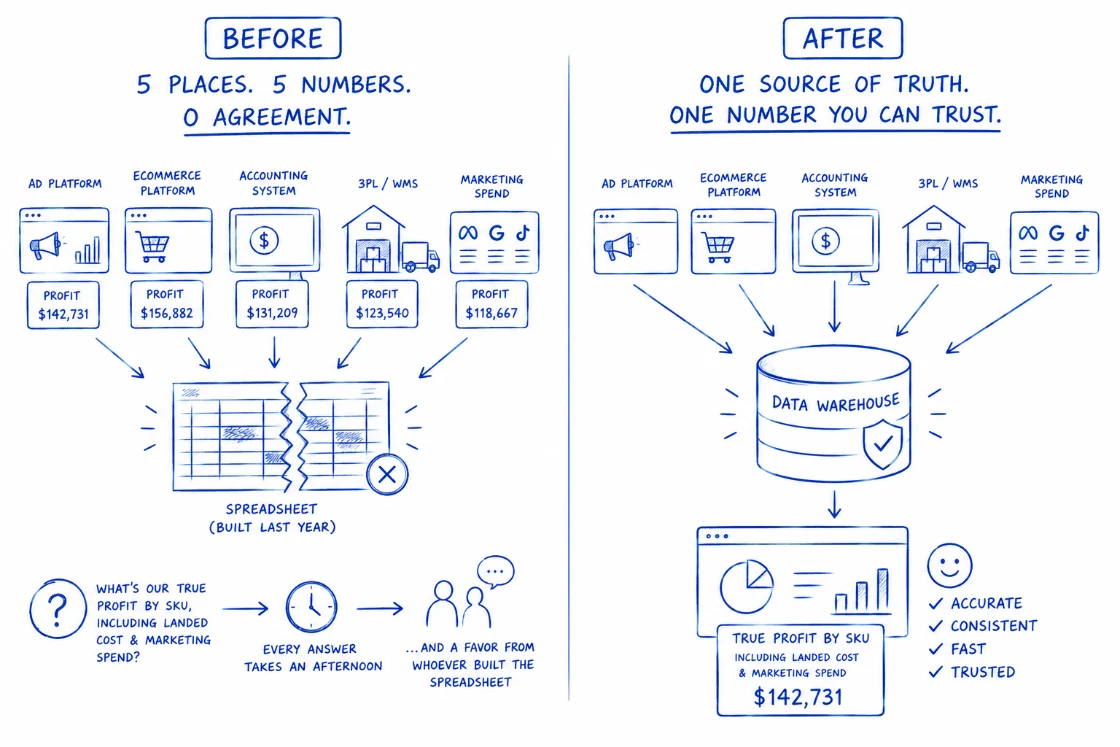
Your numbers live in five different places, and none of them agree.
Your ad platform says one thing. Your ecommerce platform says another. Your accounting system says a third. Someone built a spreadsheet last year to reconcile it all, and it breaks every time a channel changes its export. You can't get a straight answer to a question that should be simple: what's our true profit, by SKU, once landed cost and marketing spend are actually counted. Every answer takes an afternoon and a favor from whoever built the spreadsheet.
That's not a reporting problem. That's a missing source of truth.
Does this sound like you?
How it actually works
Each system stays in its lane.Your general ledger is the source of truth for money. Your inventory or ERP system is the source of truth for products, costs, quantities, and cost of goods sold. A data warehouse doesn't replace either, it sits below both.
It pulls in everything else, too.Your Amazon data, your Shopify data, your marketing data, and other external sources, all in one place, the dashboard for every KPI, the spot you run reports from, and increasingly, somewhere you can ask a plain-language question about the business and get a real answer back.
It's a sequencing question, not a first move.A data warehouse only holds up once the financials and inventory underneath it are trustworthy. Build it too early and you get a fast, confident-looking dashboard built on numbers nobody should trust yet.
A bounded decision, same as everything else.A short, vetted set of tools, scored against your actual needs and the sources you need to connect, not a sprawling technology bake-off.
Foundation first
This work sits inside the same foundation-first method behind every engagement: clean financials, then inventory, then a data warehouse, then AI, always in that order, because each layer only holds up if the one under it does. Vendor-neutral, bounded to a small set of real options, built so the business ends up owning its own source of truth instead of depending on Scott to keep explaining the dashboard.
It starts with an audit
Every engagement begins with the Ecommerce Business Audit. For a data-warehouse conversation, the audit is what confirms whether the foundation, your financials and inventory, is solid enough to build on, and surfaces which KPIs are missing before any tool gets chosen.